


a nomad has no real home, instead opting to be constantly on the move, historically moving seasonally or on a loose schedule to set temporary roots, sell wares, live off the land, etc. i’m Mauritanian – nomadic culture is in my blood (and apparently, my birth chart, but that’s another story) and bouncing from place to place is part of being a human, yes, but it’s relatively new to be any and everywhere from the “comfort” of your own home.
where do we call home more than anything these days? where do we sell our wares (and sometimes ourselves?) where else but the internet — once a lavish, limitless canvas, today a digital dystopia.
what’s left for us online? what’s our next destination?
off-rip, i have not read “Extremely Online” by Taylor Lorenz — i know her bag and i’m familiar with her work online. as a Black, Muslim, African dude, i’m sure we have different experiences with being extremely online, and definitely some overlap. i’m excited to tap into it over holidays and compare notes BUT the following five pieces aim to sketch out more of the sociological, psychological, and cultural underpinnings of the last 25 years of social media while speculating on the next step for all of us. that being said, here we go!
cybernomadism and digital migrations
“in the last 25 years, how did we go from online hunter-gatherers with tight-knit communities to creator-reactors and aggregators with exploitative practices?” an off-hand remark that made me spiral into this series. we’ve done everything on the internet and been everywhere — as new sites are being banned or blossoming, how did we get here?
“cybernomad” – not a perfect terminology, but fits the purpose of my thought process. just like IRL nomadism, it spread past continental boundaries, crossing what felt like unmapped oceans of cyberspace to find a new landing site, a new crop, new tribes of people. we sold ourselves, our time, our interests, our dreams, our perspectives, closing physical gaps between our differences one AOL free trial CD at a time.
if analog life is the so-called motherland, every generation after Gen X is a digital immigrant – don’t let me catch you trying to false flag on LinkedIn, tyler, no matter how black you act online you are white. (this is not to say that Gen X, historically invisibilized, isn’t online but more that Gen X spent more of their adolescence and adult life offline, so their brain meat was more cooked by Nirvana than Netscape in terms of development).
Millennials
the OG, fresh off the analog boats digital immigrants – came online with a dial-up modem, a screen name, and a dream all tucked away in an ikea bag (you know the one. a lot didn’t know the language, with their parents warning them about this new technological landscape that they didn’t understand; this was no longer the world of Encarta and Mavis Beacon, the internet was far more boundless and bountiful than Gen X could have ever imagined.
it wasn’t always easy but the internet being what it is today is owed to young Gen X pioneers and the Millennial generation mapping out the internet. into a hellscape, yes, but don’t completely blame the cartographers.
Gen Z
the first-generation immigrants of the internet, third-culture kids with less and less third spaces by the day. Millennials built playgrounds and Gen Z played their fucking hearts out. most of their school years and development were in tandem with the internet’s blossoming and while they’ve heard tell of the old country – you know, being outside – much of their identity is shaped by the internet’s inextricable grip on everyday life from shopping to dating to therapy to regular communication.
add formative years during a global pandemic with the doomscroll being a salve while the world waited for a solve, Gen Z gave us a glimpse into a world where community, life skills, education, etc all had to be built in isolation. antisocial or doing their best to trust in humanity as all the social and political structures and institutions that they believed had their back fell apart in real time around them? time will tell.
Gen Alpha
the second-generation immigrants who, for the most part were born with a screen and will die with a screen. Millennials, like many immigrants who still have their accent, have no idea how to understand these badass lil kids and Gen Z watches in disbelief as they freewheel through digital life with a level of insane whimsy that can only be categorized as brainrot. the convenience economy (it’s my ____ and i need it now), highly busy families (often working 7-10 jobs to afford two (2) broccolis to feed their family), and screening their way through it (“what’s cocomelon’nem talmbout?”) have joined forces like Voltron to add fuel to the fire of an interGenerational curse – being extremely online.
add boomers, Gen X, AI, social unrest (to put it entirely too mildly), a 9/11 level event happening like clockwork (where one side treats the event like Tiananmen and the other side treats it like they’ve never heard of Tiananmen, iykyk), and a (supposedly) limitless space to blend all of human experience into a curated shitpost, collectively we move from space to space online, looking for new frontiers to build a new second life as the past sites become relics, crumbling as they are lost to time (if not for digital archivists like @cyberdoula). and Gen Beta coming soon to a family near you in 2025…
is it human nature to go from place to place, tear up the place with dogma and destruction, give it the fresh prince finale look, and look for greener pastures? history says no. indiGenous people the world over have great reverence for the lands that were stolen from them.
early internet cultures seemed to be the same – early adopters had free range to create, curate, and personalize their world and found community in building a space based on shared interests, values, and collective discovery. much like with IRL indigenous people, there was conflict even before colonization – differing opinions, fallouts, different claims to spaces, and yes, some weird people who took advantage of this digital anonymity to act on real-life illegal practices (for examples, talk to close and personal friend Chris Hansen, he had some show about it).

the blurred line
“the internet isn’t real” is a sentence that we no longer can use. it’s really fucking us over.
real decisions online lead to real decisions offline. shit, real indecision online can lead to real decisions offline. i mean fake decisions online can lead to real decisions offline.
whether what we do online is real or curated, it exists within the context of the fingers that typed it, the hands that edited it, and the websites that we post them on. privacy is all but dead, but somehow, i think there's a collective feeling that it can be even worse. most of our time is spent online at this point. there will be no generation in the future that will not have a digital footprint or live hand in hand with technology.
we’ve brought human behaviors online and brought online behaviors into our real life – a post, a like, a retort, a comment, the drive to comment in the first place, the search for the right post that will make us say “that’s enough internet for today,” whether it be hilarious or horrifying, has altered our brain chemistry.
dopamine and serotonin must reach historical levels to register a blip on the happiness scale. the evolution of our brains in response to the constant stream of information contributes to collective rises in ADHD, anxiety, and addiction to smartphones. and our offline behavior has matched the dystopia of the times beamed directly into our eyeholes – to get through it, we either heehee, haha, boohoo, or all of the above. the algorithm tailoring makes the internet more about us – our wants, our needs, what store we said we wanted to go to, what sites we should visit, what things we should buy.
with us spending our days forcefed our desires (past, present, and future), is it any wonder why everyone is a narcissist (except you, you're perfect, everyone else is crazy)?
“we are the internet, the internet is us” also doesn’t sound right. if it’s curated, it’s not real, is it? if it’s edited, doesn’t that make it, idk, “inadmissable evidence?” or perhaps it’s like the observer effect but maybe “creator effect.”
“we are the creators of our own reality” is such a simple self-help tony robbins ass take but are we creators of a whole reality or a projection? perhaps this is a Millennials ass question but, who’s the real us: the online one or the offline one?
is this the real life?
i’ve long held the opinion that the current state of the internet promotes two-facedness — nah, fr, think of the most two-faced person you can think of? extremely online, right? three accounts, one real, one “the real them,” one for completely normal totally fine stalking behavior? okay maybe three-facedness? four? i guess that’s “containing multitudes.” or is it “performing multitudes?” either way, a lot of tudes. are we on an endless tour, a carousel of content creation, a circus ride that won’t let us off, no matter how much we throw up?
years ago, i ran a video at a twice-dead digital media company about dramaturgy. not the beloved thespian nerds who help construct all of our dramatic productions but the sociological perspective that Erving Goffman (also a nerd) introduced as a framework that uses theater as a filter for how we look at the world. very “all the world’s a stage and all the men and women and non-binary dj/baristas/creative directors/thought leaders/stand-up comedians in it merely players.” we all have our entrances and our exits, and everyone in their time plays many parts — sometimes all at once.
my thesis at the time: social media makes us perform a version of ourselves online that is slowly consuming the rest of our personhood offline. Goffman used two main periods of time — “front stage” and “back stage” — to discuss spaces we occupy in our lives and “impression management” to describe the actions that we undertake to maintain our image/reputation. There’s so much more to this lane of thinking but let’s keep it simple for our purposes here – I’m not trying to alienate anyone by digging so far into theory that we end up up our own assholes.
i’m not here to go back-and-forth about the opinions about this framework of understanding or to get into how this framework how important this is to the larger sociological community (i’m just a silly little guy who be thinking sometimes) but i think that the editing room floor of all of our real, tangible lives hold so many stories that we either tell each other or tell ourselves about each other or ourselves and the motivations to tell them.
interpretation and intention, once in rhythmic dance have become fighters online and often people have found one, the other, or both at odds with their curated image, their digital projection and that fascinates me.
every photo where we crop someone out, every notes app apology, every highly stylized photoshoot, every face-to-cam “i don’t care about ____” is a story and why we chose to leave parts out (especially important context) is interesting to me.
there’s always “more to the story” and what gets cut out feels like it’s not “important to the narrative” – what narrative? who wrote it? who’s writing it right now? why?
ok, i see why my therapist calls me an overthinker.
my thesis now: due to constant surveillance, no way to opt out of that surveillance, our behaviors mined for 25 years and turned into data profiles, and the perpetual move towards the ouroboros of becoming the very content we consume, everyone is in a constant state of performance with no offstage, adding to all of our stressors.
what is a “platform” but a stage, a dais, a soapbox, a spotlight where the show must go on or do you even exist?
all of us are becoming method actors even jeremy strong would say should fucking relax. we perform our political affiliations, our gender identity, sexuality, intelligence, horniness, fandoms, standoms, aloofness, bitchiness, dickheadedness, single life — we even perform our performance.
does that make us fake? no, but the containers in which we all collectively perform ourselves seem like a buffet of options but in actuality, we’re chewing each other/ourselves up and creating a slurry where bits and pieces of specificity are being turned into an unidentifiable, hyperbolic, supersubjective, overgeneralized mess.
[*cracking open my social media app of choice* let’s seeeeee genocide in Gaza, next reel not so subtle onlyfans ad, next one actual ad, joke, nostalgia, different genocide, news story, oh shit syria (good for them), podcast clip, joke, meme, bomb blast, an ad for bomb shelters, “here’s why you’re actually bad for wanting a free syria,” school shooting, a commercial for movie based on the first genocide, finally a photo of a friend from…3 fucking weeks ago??” — all this in 20 thumb swipes. is this…me? missing the point, missing out on my life, missing a deal to buy a killer bomb shelter? it can’t be. but it is me?) is it?
(this drove me nuts in 2019 and 2020 and i took a giant step back from social media presence because a break from reality and low level crash out was imminent — i needed to return to offline life and not a day goes by that i regret it)
is it any surprise we’re all losing our minds? losing our capability to feel deeply for more than 90 seconds at a time and embracing failing quickly? even before AI started hoodwinking our elders on Facebook (and some of our young people too), everything feels super real and everything feels incredibly fake and “performative” all at once; less 1984 and more 1985 — subjective truth has long vanquished objectivity but objective seriousness and subjective silliness are beating the brakes off of each other in every comment section in the world.
we’ve created new digital social archetypes, ones that become shorthand (for better or for worse) for the labels for all we love and hate about the people we love, we hate, hate to love, and love to hate.
is that anything new? no, but the speed with which we create this new lexicon creates new roles with new robes that we’re forced to wear with pride or shame — it’s a digital fast fashion, shein and temu for personalities, our 9th psychiatric disorder (this month), our 10th healing journey (this week), and perspectives built from popularity and trendiness, not pedagogy and moral tenacity. culture can become a costume in a place like this, any and everyone can wear that online culture as a costume like ‘03 gwen stefani luxurious (it’s one google away, have fun).
“do I detect a corporate lick? yessirrrr”
human beings are social creatures shackled to a system that denies our humanity. it’s that simple, the more abstract we get, the more eyes glaze over. as humans, we have needs whether they’re existential ones or value-based: clean air and water, shelter, safety, belonging, esteem, the space for self-actualization, etc. the internet didn’t fix any or all of these but it opened up space to find belonging, find your people, your tribe, and curate/manage your own aesthetic needs.
the rise of the internet in the 90s and 2000s turbo-charged the four cs:
community – it didn’t have to be in your town, you can find people with your niche interest, social affiliations, cultural ties, etc all around the world
communication – yeah it was text-based and slow-loading videos and photos and gifs (the way you pronounce it is wrong btw)
connectivity – you could connect with people in a myriad of ways as long as you had fast internet — send music, movies, money, etc easier to family and friends
convenience – snail mail no more, that message is an email, an instant message, a package, a necessity, all from the comfort of your own home
the physical map was being redrawn by the internet, time was being warped – “across the country” became a few keystrokes away and “two weeks from now” became “any minute now” – it’s as if the space-time continuum was being shrunk. “no need to go outside, we got outside inside now!” schroedinger’s digital native? who knows but the internet was the future — our present. there were two timelines and the world slowly adopted the speed of internet and maybe we weren’t ready for it.
a digital third space that parents just didn’t understand, the world wide web became the place to be for relevancy, especially amongst the youth. it was the world’s biggest arcade and everything was a game. a direct-to-consumer platform? where the youth – a target demographic with parents and disposable income – would share? them money makers dove right tf in because where there’s a human need, there’s money to be made if you can capitalize on it fast enough – if only there was a name for a system of exploitation that prioritizes profits over product or population…
a new frontier and there was capitalism, rubbing it’s hands together like birdman, waiting to do what it’s done since its inception. brands did it with TV and film in the 50s and it’s a mainstay of legacy media since – why else do you think we’re moving back to the “commercial break” model?
an at bat, a swing, and mad misses
it would be disingenuous to pretend that i don’t worry about our collective ability to create a new world.
we’ve been given chance after chance and the sins of the analog world unchecked in an experimental new one clogged and cluttered healthy community, connection, and communication, and made convenience inconvenient to social development.
look around.
echo chambers have become echo fortresses
the ultrarich are reaching their own cash ceiling, “gridlocked” by the limitations of the planet and the law, now looking to the stars for a new physical realm to lay claim to
we the people are fighting against them the people who hate us the people.
if there was a hard cultural reset tomorrow — i’m talking no capitalism, no patriarchy, no white supremacy, no religious supremacy, no ableism, no settler colonialism, gender essentialism, or -phobias — what would we create? how quickly would it be built? how quickly will it crumble?
even a glimpse at class consciousness and bipartisan american unity, when Luigi Mangione took matters into his own hands, was ephemeral – people found out he’s a tech bro, without a theory-heavy manipesto (did it again, fuck) and hot (cutie patootie confirmed) and the conversations shifted because he wasn’t the robin hood we imagined him to be. we were this close – the puritanism and enforced binaries of reactionaries met the elite performed pearl clutching that moved the flame of rebellion to burn candles of unbridled horniness and increasing apathy (i still hold out some hope).
i’m sorry Nikki Giovanni (RIP), it’s hard to find joy and hope in times like this. to pretend that i live in a constant state of hopefulness and joy is insincere – i heehee and haha but everything hurhurts, especially after all these near misses at solidarity. after George Floyd, the word “abolition” went the same route as “woke” – it’s all but meaningless because it was run into the ground. the tenets of the practice of abolition still exist albeit obfuscated by the vague use of it by those who intentionally or unintentionally blur the definition to make it mean everything, nothing, or a secret third thing.
abolition is possible but it doesn’t just require an institutional overhaul and rebuild but a personal one alongside it — one i don’t see internalized but rather performed online. quick to say “why ain’t y’all [insert something X learned about yesterday],” slow to rearrange personal values to align with this new perspective – reactive and projecting as opposed to responsive and evolving.
i’m not here to say “ain’t no one doing the work but me,” that’s equally disingenuous – plenty are and many do more than my part. i’m saying we all have to do the work, agree on what the work is, and do our part to create the world we want to live in or we’re gonna build something ugly and default to the ugly ass world we’re used now.
on its face, it seems impossible and too simplistic. “create the world we want to live in.” why is this so hard? so many answers from education to capitalism to colonization to misogyny or ableism – i’m not here to give that answer, we’ve overdiagnosed the issue. the earth is dying, we are losing recipes, traditions, rights, time, and it feels like we’re all resigned to oscillating between the anger and acceptance phases of grieving. but it’s not over.
we’ve tried to create a new world before, or rather, a projected world online with our avatars, that have translated our multiplicity into binary, polarizing spaces. accounts where a curated version of our complexity is considered the real us and raw human contradictions are considered aberrant. imperfect but we tried.
in moments of sobering lucidity, i fall into the Wachowski Sisters imagination: is online it the real world at this point? what’s the line and can we go back? did we create our own Matrix where the false space is real and the tangible reality is inauthentic? i feel like we were force-fed both red and blue pills and we’re seeing the side effects.
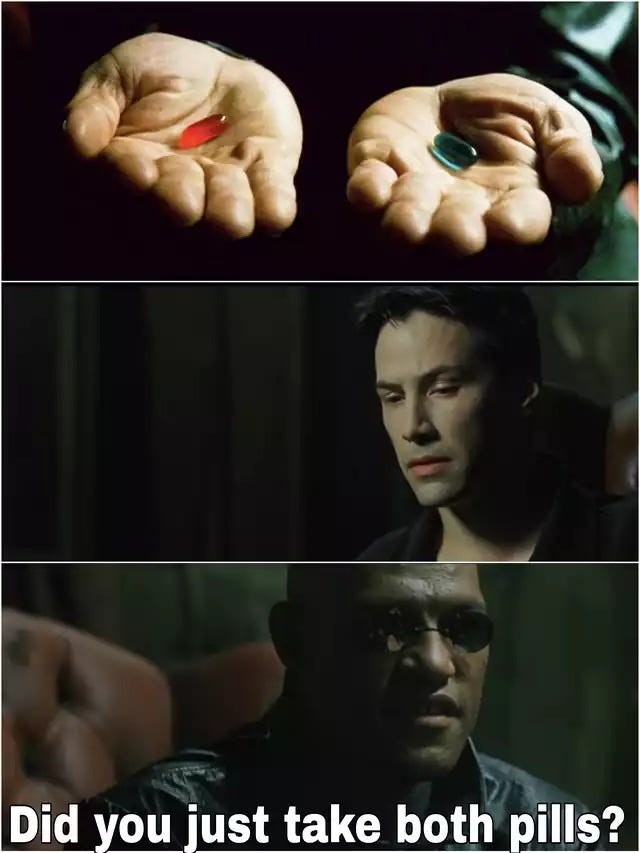
seeing used to be believing but now believing is optional, no matter how visceral or contrary to the propagandist messaging the truth is. and even if it is the truth, is it a lie come to life/light? or an acceptance of an Orwellian subjectivity that will just be debunked in the future? is that Matrix collective or is it a personal, subjective matrix for just us, our beliefs, our delusions, our programming? how do we break free?
what world have we created online?
subject to change but, today’s answer: we created recorded history again, with capitalism as the battery, just quicker.
a playbook/framework i’ve landed on:
step 1: arrive, make account, find your people
step 2: enjoy the site and what it provides
step 3: capitalize off of the site (algorithms, SEO, businesses)
step 4: oversaturate the site (ads ads ads)
step 5: opt into the subscription model (or lose everything)
step 6: operational collapse and enshittification
step 7: seek refuge in new “better” site
step 8: repeat (over and over, faster and faster)
everywhere we go, we are and we’re being consumed by the machine.
AltaVista. Agora Road. Melon Land. Something Awful. Newgrounds. eBaum’s World. private blogs for gossip, music, parenting, fandoms, etc. all feel paleolithic at this point but that’s the proto-online communities that a real digital anthropologist could excavate to explain how we got to where we are today – posts on those forums feel like cave paintings at this point. fast forward to 2024, we’ve run out of online space – the cave walls are splattered with loose posts of eras past, sins unwashable by hail marys are encoded in our digital histories, in between ads for feastibles and betterhelp ads.
the story of social media era internet is the story of human recorded history on 10x speed so, let me be a digital sociologist, gathering my thoughts on our digital migrations, in context with both our online and offline history. i might dabble in narrativizing, some light diagnosing, and theorizing why our online present is like this and what an online future could look like if nothing changes, pitching some potential solutions before it’s too late (or rather before it’s too late again).
join me on a quick series retelling of the last 25 years of social media of cybernomadic history as our online travels bump on the edges of digital possibility.
next: the first extremely online age and charting a new digital frontier 🌱🌱